

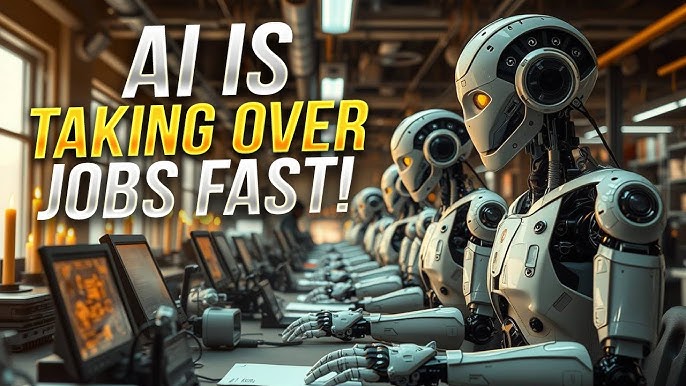
Artificial Intelligence is no longer a future concept—it is actively changing the global job market right now. From offices to factories and even creative industries, AI is automating tasks that were once done by humans. This rapid transformation is raising concerns about job security, career stability, and the future of work. As AI tools become smarter and more accessible, traditional jobs are being reshaped or replaced faster than most people expected. Understanding this shift is important for workers, businesses, and students preparing for future careers.
How AI Is Transforming the Job Market
Automation of Repetitive Work Tasks
AI is rapidly taking over repetitive and time-consuming tasks across many industries. Jobs that involve data entry, scheduling, basic customer support, and document processing are increasingly being handled by intelligent systems. This shift allows companies to reduce costs while improving efficiency and accuracy. As a result, roles that depend heavily on routine work are becoming less secure, pushing workers to adapt or reskill for more complex responsibilities.
Rise of AI-Powered Decision Making
Modern AI systems can analyze large amounts of data and make decisions faster than humans. In industries like finance, marketing, and logistics, AI is being used to predict trends, optimize operations, and support business strategies. This reduces the need for large teams of analysts and decision-makers. Instead, companies rely on smaller teams that supervise AI outputs, changing the structure of traditional corporate jobs.
Shift in Workforce Demand
As AI adoption grows, the demand for certain jobs is decreasing while new roles are emerging. Traditional positions are being replaced by roles focused on managing, training, and maintaining AI systems. This shift is creating a gap between old skill sets and new industry requirements, making continuous learning essential for job survival in the modern workforce.
Industries Most Affected by AI Job Replacement
Manufacturing and Industrial Automation
Manufacturing is one of the earliest and most heavily impacted sectors. AI-powered machines and robotics are replacing manual labor in production lines, quality control, and packaging. These systems work faster, more accurately, and without fatigue. As a result, many traditional factory jobs are being reduced or completely eliminated, especially in large-scale production environments.
Customer Service and Support Systems
AI chatbots and virtual assistants are transforming customer service operations. Many companies now use automated systems to handle inquiries, complaints, and basic troubleshooting. This reduces the need for large customer support teams. While human agents are still required for complex issues, the majority of routine interactions are now managed by AI systems.
Finance and Administrative Roles
The finance industry is also experiencing major changes due to AI. Tasks such as accounting, auditing, fraud detection, and report generation are increasingly automated. Administrative roles that involve scheduling, data management, and documentation are also being reduced. AI systems can process financial information more quickly and with fewer errors, making traditional roles less essential.
The Future of Work in an AI-Driven World
Evolution of Job Skills Requirements
As AI replaces traditional jobs, the skills required in the workforce are evolving rapidly. Employers now prioritize digital literacy, problem-solving, and AI-related knowledge. Employees who understand how to work alongside AI tools have a better chance of staying relevant in the job market. This shift is pushing individuals to continuously upgrade their skills to match industry demands.
Growth of Hybrid Human-AI Roles
Instead of fully replacing humans, many companies are creating hybrid roles where humans and AI work together. These jobs involve supervising AI systems, interpreting outputs, and making final decisions. This collaboration increases productivity while still relying on human judgment for complex tasks. Hybrid roles are becoming a key part of the modern workforce structure.
Increasing Importance of Creativity and Critical Thinking
AI is strong in automation and data processing, but it still struggles with creativity, emotional intelligence, and critical thinking. As a result, jobs that require human creativity and strategic thinking are becoming more valuable. Professionals who can think beyond data and bring unique ideas to the table will remain highly in demand in the AI-driven future.
Adapting to the AI Job Market
Importance of Continuous Learning
To stay relevant in an AI-driven economy, continuous learning has become essential. Workers need to regularly update their skills through online courses, certifications, and practical experience. Learning about AI tools and digital technologies can significantly improve career opportunities and job security in the long term.
Reskilling for Future Careers
Many traditional roles are evolving into new job categories. This makes reskilling an important strategy for career survival. Individuals who transition into fields like data analysis, AI management, or digital marketing are more likely to succeed. Reskilling helps bridge the gap between outdated job roles and future employment needs.
Embracing Digital Transformation
Businesses and employees must embrace digital transformation to stay competitive. This means adapting to new technologies, using AI tools effectively, and improving workflow efficiency. Those who resist change may struggle in the long run, while those who adopt new systems can benefit from better opportunities and growth.
FAQs
1. Is AI really replacing traditional jobs?
Yes, AI is replacing many repetitive and manual jobs, especially in industries like manufacturing, customer service, and administration.
2. Which jobs are most at risk from AI?
Jobs involving routine tasks such as data entry, basic support, and manual processing are most at risk.
3. Will AI create new job opportunities?
Yes, AI is also creating new roles in technology, data science, AI management, and digital industries.
4. How can workers stay safe from job loss due to AI?
By learning new skills, adapting to digital tools, and reskilling for modern job roles.
5. Is AI replacing all jobs?
No, AI is not replacing all jobs. It mainly replaces repetitive tasks, while creative and strategic roles remain essential.
Conclusion
AI is transforming the global job market faster than expected, replacing many traditional roles while creating new opportunities at the same time. Although automation is reducing the demand for repetitive jobs, it is also increasing the need for advanced skills, creativity, and digital expertise. The future of work will depend on how quickly individuals and businesses adapt to this change. Those who embrace learning and technology will be better prepared for the evolving AI-driven economy.